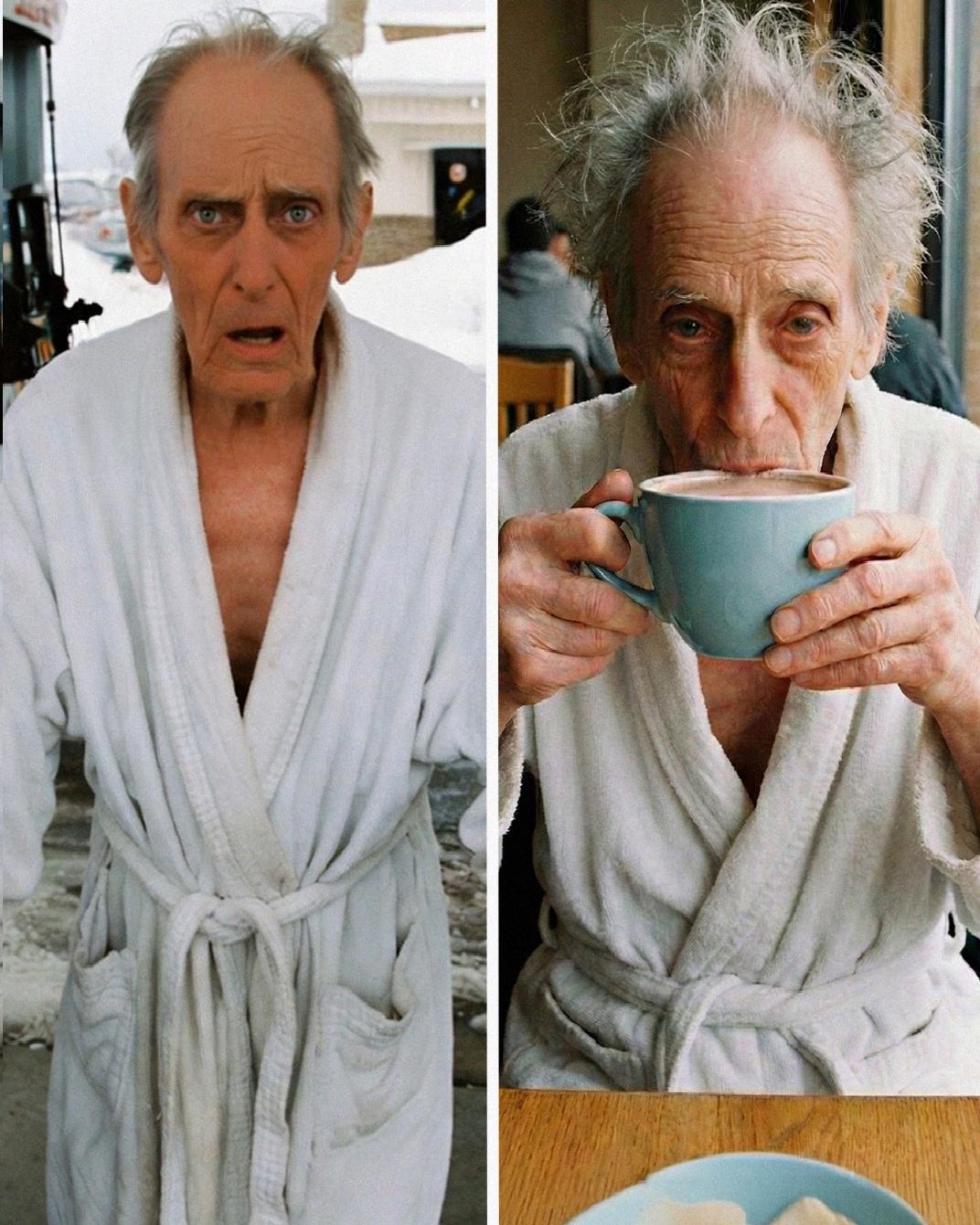
I’m a cop, and I’ve seen plenty of hard things on the job. But nothing prepared me for finding an elderly man shivering at a gas station in just a bathrobe while crowds ignored him. I took him home that day, and months later, his children discovered exactly what their cruelty had cost them.
That Thursday morning started like any other brutal shift ending. I’d been up for 16 hours straight, dealing with a domestic dispute, two traffic accidents, and paperwork that never seemed to end. All I wanted was coffee and my bed.

But nothing prepared me for finding an elderly man shivering at a gas station.
I pulled into the gas station on Main Street just as the sun was climbing over the buildings, casting long shadows across the parking lot. The place was busy. Commuters were grabbing breakfast, and truckers were fueling up, the usual morning chaos.
That’s when I saw him.
An old man was standing near the entrance, wearing nothing but a faded blue bathrobe and slippers. His body shook violently in the cold morning air. His hands clutched the fabric around his chest as if it might somehow keep the world out.
People streamed past him. Not one of them stopped.
A businessman in a sharp suit glanced at him and quickened his pace. A teenage girl wrinkled her nose and whispered to her friend. Someone else muttered that security should handle it.
But nobody did anything. They just kept walking, pretending he wasn’t there.
I couldn’t do that.

I got out of my car and approached slowly, keeping my hands visible.
“Hey there, sir,” I said gently. “Are you okay? Let’s get you inside where it’s warm.”
His eyes met mine, watery and confused.
“I can’t…” he stammered. “I need to find my wife. She’s waiting for me.”
My chest tightened. I guided him into the café, the warmth immediately easing his shaking. I ordered him a hot tea and sat with him in a corner booth away from the stares. He wrapped his hands around the cup like it was treasure.
“What’s your name, sir?” I asked.
“Henry,” he said after a pause. “My name is Henry.”
As he sipped his tea, the story came out in pieces. His wife had died three years earlier. After that, dementia crept in — not enough to erase who he was, but enough to leave gaps that confused and frightened him.
That morning, he’d woken up thinking about the old days. About stopping at that gas station with his wife on Sundays. About sitting together in a booth by the window.
So he went looking for her, forgetting she was gone.
“Do you have family?” I asked. “Someone I can call?”

He nodded and pulled out a small, worn pocket diary filled with names and numbers written in shaky handwriting.
I stepped outside to make the calls. I don’t know why I expected his children to care, but I did.
His son answered, annoyed. When I explained the situation, he sighed.
“Again? We’re on vacation. We can’t deal with this right now.”
“He’s confused and scared,” I said. “He needs someone to come get him.”
“He’s become a burden,” the son replied flatly. “Handle it.”
Then his daughter came on the line.
“We have lives,” she said sharply. “Find him a shelter or something.”
“You’re telling me you won’t come for your father?” I asked.
“That’s exactly what we’re saying,” she snapped. “He’s just in the way now.”
The line went dead.

I stood in the parking lot for a long moment before walking back inside.
“My kids… are they coming?” Henry asked hopefully.
“They’re tied up,” I said softly. “But you’re not alone.”
I brought Henry home with me that afternoon. I lived with my seven-year-old son, Jake, and my mother, who’d moved in after my divorce.
Over the next few days, Henry became part of our family. Mom cooked meals that reminded him of his wife. Jake listened wide-eyed to his stories. The structure and care steadied him in a way nothing else had.
I learned the truth soon enough. His children weren’t just neglectful — they were waiting. Waiting for him to disappear so they could inherit everything.
Henry had worked 40 years as a machinist. He put both kids through college, paid for weddings, helped them buy homes. And they treated him like an inconvenience.
“I gave them everything I had,” he told me quietly. “I hoped it would make them good people.”
Three months later, Henry called me into his room. He was holding an envelope.
“My lawyer came today,” he said. “I made a new will.”
Everything he owned — the house, savings, insurance — was left to me, my son, and my mother.
“I already gave my children everything a father could give,” he said firmly. “They chose who they wanted to be.”

When his kids found out, the anger was explosive. His son accused me of manipulation. Threatened lawsuits. None came.
Henry sent them one final letter, saying goodbye.
He passed away two years later, peacefully in his sleep. Jake cried like he’d lost a grandfather — because he had.
The inheritance changed our lives, but I didn’t keep it for myself. I opened a small care center for elderly people facing dementia and abandonment.
We called it Henry’s House of Hopes.
My mother runs it now. Jake volunteers on weekends. And I still work on the force, always watching for the person everyone else walks past.
Henry taught me this: family is proven by care, not blood. And compassion isn’t weakness — it’s the strongest thing we have.
