You never forget the people who show up when you need them most — even if they disappear without a word. Decades after a childhood encounter I thought was long buried, one unexpected phone call brought it all rushing back.
I’m 41. The kind of woman who keeps spare granola bars in her glove box because life has taught me that you just never know.
When my phone lit up with an unknown number on a dull Tuesday afternoon, I almost let it ring out.

But something made me swipe to answer. Maybe it was habit. Maybe intuition.
Either way, I was not ready for the voice that followed.
“Good afternoon, ma’am,” a voice said. “I’m your friend Charlotte’s attorney. She left instructions to contact you. I want to invite you to my office. It’s important.”
I didn’t even make it to a chair. I sat straight down on the kitchen floor like someone had cut the strings holding me up.
Charlotte. I hadn’t heard her name in 30 years.
She wasn’t family or a neighbor in any official sense. But she was something else entirely.
She was the one adult who had ever looked at me as if I weren’t a problem to be solved or a burden to be ignored.
When I was a child, my world was all sharp edges and cold silences.
My mom, Erica, was caught in a revolving door of boyfriends who either left or stayed too long. My stepdad, Dave, treated yelling as if it were his second job.
I got good at disappearing. At not asking. At never needing anything, not even food.
School wasn’t a safe place either. Poverty clings to kids like smoke.
The other girls could sniff it on my thrift-store jeans and wrinkled shirts. Teachers tried to help, but only made things worse. I didn’t talk much, smile much, or get invited anywhere.
And then, one freezing afternoon, when I was 11, I saw her.
I was walking home from school because, as usual, the car wasn’t “working again.” That was my mom’s excuse for being too broke to buy gas.
My hands were tucked into my sleeves, teeth clenched, and all I could think about was whether the heat would be on when I got home.
The woman was there on the side of the quiet road.
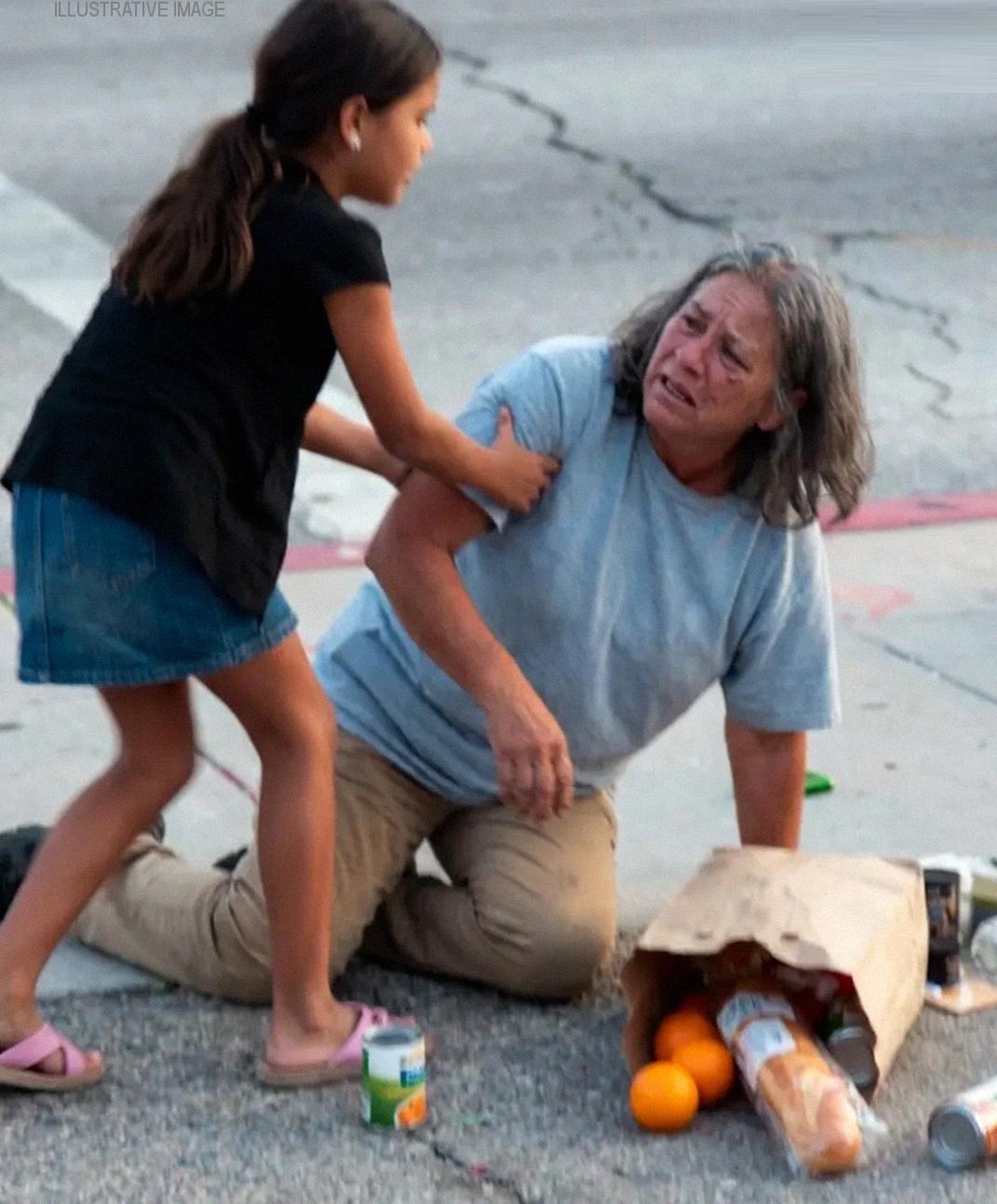
She was hunched and clearly trying to stand, one knee on the pavement, trembling as if she’d fallen and couldn’t get up.
Her grocery bag had exploded — eggs cracked open on the blacktop, yolk mixing with dirty slush, and an orange rolling into the ditch.
She looked embarrassed. Not panicked or hurt.

I hesitated. Kids like me don’t stop. We learn young that helping strangers draws attention. And attention, more often than not, means consequences.
But then she lifted her eyes and said, in a voice barely a whisper, “Sweetheart… could you help me?”
Something in my chest cracked.
I knelt, gathered the groceries with frozen fingers, and offered her my scarf. It was thin and barely warm, but I gave it anyway. She looked surprised — and smiled.
I walked her home, one slow shuffle at a time.
Shaking and exhausted, she told me her name was Charlotte. She was 50 and had been walking home from the store when she suddenly felt weak and fell.
She lived in a small house, the kind you’d miss if you blinked.
Inside smelled like Vicks, cinnamon, and old books.
She poured hot cocoa and slid half a turkey sandwich across the table like she’d made it just for me.
I ate like I hadn’t eaten all day — because I hadn’t.
She didn’t ask questions that would get me in trouble. She just said gently, “You shouldn’t have been alone out there.”
Then she added, “If you ever need warmth or a snack, you knock.”
And I did.

Over the next year, I became a regular guest in her world. I never told anyone.
Charlotte was my secret. My safety net in a life full of trapdoors.
I showed up with bloody knees, tear-stained cheeks, and an ache I couldn’t name.
She made soup, taught me how to sew buttons, fold sheets, and write thank-you notes. Sometimes I didn’t speak at all. She let silence be enough.
Once, when I showed up in a snowstorm without a coat, she draped one of hers around me — altered to fit.
“I know you don’t want charity,” she said. “So let’s call this what it is: community.”
For a while, she was the reason I believed the world might not be all sharp edges.
Then, just like that, she was gone.
One week the porch light flickered. The next, the house was dark. Curtains gone. No trace.
I knocked until my hands hurt.
A man finally answered. “The lady moved out. Don’t know where.”
I was devastated.
No goodbye. No note. Just silence.

I grew up. Moved away. Had a daughter of my own.
But I never forgot her.
I spent years telling myself, “Even the kind ones leave.”
So when the lawyer called, I thought it had to be a scam.
Still, I went.
The attorney, Dennis, explained that Charlotte had left very specific instructions to find me.
She had kept a photo of me — holding a mug with marshmallows, my school crest visible on my backpack. From that, they traced me.
“She never forgot you,” he said.
Then he handed me an envelope.
On the front, in shaky handwriting, were the words: “For my brave girl.”
Inside was a letter written the night she disappeared.
She explained that she had fallen ill, been found confused, and taken away by family. She didn’t know my last name. She tried to come back. She tried to write.
“They said I imagined you,” she wrote. “But you were real.”
I sobbed.
She hadn’t abandoned me. She had fought — and no one listened.
“She wanted you to have her home,” Dennis said.
In her will, she had left it to me.
Along with keepsakes: my childhood library card, the photo, a thank-you note I’d written, and a note explaining I reminded her of her granddaughter, Lila, who had died young due to neglect.
Charlotte had been grieving too.

She found me during her lowest moment — and chose love.
I visited the house that weekend.
Inside was the same table, the same chair I used to sit in, the same kettle.
In a box labeled “For Her” was the coat she gave me, her soup recipe, my drawing of her house, and a photo of us together at the table.
She had kept everything.
That night, I told my daughter the real version of my childhood.

A few months later, I placed a small plaque on the porch:
CHARLOTTE.
She gave people a place to feel safe.
I turn on that porch light every night.
It still flickers.
And sometimes, wrapped in her coat, I swear I can hear her kettle whistle and feel her hand in mine.
Maybe love doesn’t always show up when you expect it.
But sometimes — if you’re very lucky — it finds you anyway.
Even 30 years later.
